
Ancient Capitals of
Asuka and Fujiwara
Click here for tours to experience the Ancient Capitals of Asuka and Fujiwara!
Learn more
Aiming for inscription on the UNESCO World Heritage List in 2026!
About the Ancient Capitals of Asuka and Fujiwara
Asuka-Fujiwara represents the process by which Japan’s first centralized state system was established between the late 6th and early 8th centuries, as illustrated through the transition of two successive capitals. Through political and cultural exchanges with China and the Korean Peninsula, Japan achieved a unique development by integrating foreign influences with its indigenous traditions.
This property consists of two ancient capitals located in the southern part of the Nara Basin — Asuka and Fujiwara. The capital of Asuka centered on the Emperor’s palace, surrounded by government offices, while the capital of Fujiwara integrated major governing institutions — such as the Daigokuden (Great audience hall), Chodoin (State halls), Dairi (Imperial residental quarters), and Government offices — within a single palace compound on the plains. The transition between these two capitals demonstrates the development of Japan’s early capital system based on the Chinese ritsuryō model of centralized governance, marking the starting point of palace construction that would later evolve into the Nara Capital and Heian Capital (Kyoto).


History
Around 1,400 Years Ago
Asuka
–The period that shaped "Japan"
The Asuka Period refers to the approximately 120 years between the enthronement of Empress Suiko at Toyura palace in 592 CE and the relocation of the capital to Nara Capital in 710. During this era, Japan took shape as a nation through repeated political reforms and upheavals — including the dispatch of envoys to the Sui Dynasty China, the establishment of the Seventeen Article Constitution, the Incident of Isshi, the Reformation of Taika, the Jinshin Disturbance, and the promulgation of the Taiho Code.
From the reign of Emperor Jomei onward, the imperial palace continued to be located at Asuka Palace.The structure of the palaces during the Asuka period evolved in a manner that reflected the contemporary concept of nation building.With the establishment of the ritsuryo state system, more government offices were added around the palace, along with a garden, a water clock tower, and ritual facilities — all of which demonstrate the growing sophistication of the state at that time.
During the Asuka period, the first Buddhist temples were built in Japan, and Buddhism began to spread. Beginning with Asuka-dera Temple, whose construction began in 588, numerous temples such as Tachibana-dera Temple, Yamada-dera Temple, and Kawara-dera Temple were constructed.
These were tile-roofed, stone-based structures introduced through technologies brought by immigrants and students from East Asia, in sharp contrast to the Asuka palaces, which were post in ground buildings — a traditional Japanese architectural style handed down since antiquity.
This period marked the end of the Kofun culture. Burial mound styles evolved from large keyhole-shaped tombs to square or octagonal mounded tombs influenced by Chinese culture, reflecting a worldview centered on the emperor. Among them, the mural paintings of the Takamatsuzuka Mounded Tomb and Kitora Mounded Tomb vividly demonstrate the transmission of artistic and philosophical ideas across East Asia.
Around 1,300 Years Ago
Fujiwara
–Palace The birth of an ancient capital
As Asuka Basin became cramped, plans were made to construct a new capital on the plains to the northwest, embodying a worldview centered on the emperor under the ritsuryo state system. In 694 CE, the Fujiwara Palace was completed.
Situated near the center of the three Yamato mountains, the palace compound measured approximately 900 meters on each side, enclosed by 5.5-meter-high tall fences. Within the central area stood the Dairi (Imperial residental quarters), Daigokuden (Great audience hall), and Chodoin (State halls), marking the first use of Chinese-style tiled-roof buildings with stone foundations in Japan.
Government offices of the “Two Ministries and Eight Departments” were arranged in blocks to the east and west. This organization, which consolidated administrative offices previously dispersed around the Asuka palaces, reflects the establishment of a centralized state system that had gradually evolved during the Asuka Period.
Around the Fujiwara Palace stretched a planned capital laid out in a grid-pattern of streets (the jōbō system), covering an area approximately 5.3 kilometers square — encompassing even the three Yamato mountains. Officials were allocated residential plots according to their rank, while temples and government offices were distributed within the capital.
The Daikandaiji and Motoyakushiji Temples, both state Buddhist temples, were built to the east and west, respectively, of the area south of Fujiwara Palace, and they served as the head temples of the capital.
In particular, the nine-storied pagoda of Daikandaiji Temple served as a symbol of the Buddhist ideal of safeguarding the nation’s peace and stability.
The centralized state system formed in Asuka reached completion in Fujiwara, and the proclamation in 701 CE that “Bunbutsu no gi, Kore ni sonawareri(the institutions of civilization are now complete)” declared the full establishment of the nation known as Japan, with a newly organized capital as its foundation.
Join the Tour Here
The Origin of Ancient Japan
— Asuka-Fujiwara Highlight Tour
Travel back over 1,300 years and explore the origins of Japan. This one-day bus tour takes you to the highlights of the Asuka–Fujiwara area, a World Heritage nominated site. See with your own eyes the ancient palaces, massive stone tombs, and Japan’s oldest Buddhist statues. With expert guides, you’ll experience the unfolding story of Japan’s earliest history in depth.
Asuka Cycling
— Tracing the Footsteps of Japan’s Powerful Empresses
Ride through the ancient land of Asuka on a refreshing cycling tour! The stars of this journey are Japan’s influential empresses who once shaped the nation. Visit the scenic landscapes and mysterious ruins they cherished. This is more than sightseeing—it’s an active, immersive experience where you can feel the living spirit of history.
An Immersive Cultural Journey in Ancient Asuka
— Awaken All Five Senses
Go beyond sightseeing and experience Asuka with all five senses. Calm your mind through sutra copying, savor the blessings of the land through soy sauce brewing and farming experiences, and spend a tranquil night beside the Ishibutai Mounded Tomb, wrapped in ancient silence. This two-day journey offers an authentic and deeply enriching encounter with the essence of Japan’s history and culture.
Component Sites to Explore by Tour
Asuka Palace Site
The four palaces that form the core of the "Asuka Capital"
It served as the residence of four successive emperors. For the first time in Japanese history, the imperial palace was rebuilt on the same site instead of being relocated with each new reign.

Sakafuneishi Ritual Site
A ritual site dedicated to the worship of water, hidden in the hills surrounded by stone embankments.
The Sakafuneishi stone on the hilltop and the sacred water flowed to a turtle-shaped stone basin below, where imperial rituals were performed by the emperor.
.jpg)
Fujiwara Palace Site
The palace where the ritsuryo state of “Japan” was completed.
In the nearly one-kilometer-square palace grounds, the Daigokuden (Great audience hall) stood at the center, surrounded by the Chōdō-in (State halls) and government offices, embodying the centralized state system.

Asuka-dera Temple Site
The site of Japan’s first full-scale Buddhist temple.
The knowledge and construction techniques introduced during the building of Asuka-dera Temple greatly influenced the development of later palace, temple, and tomb architecture throughout Japan.
_1.jpg)
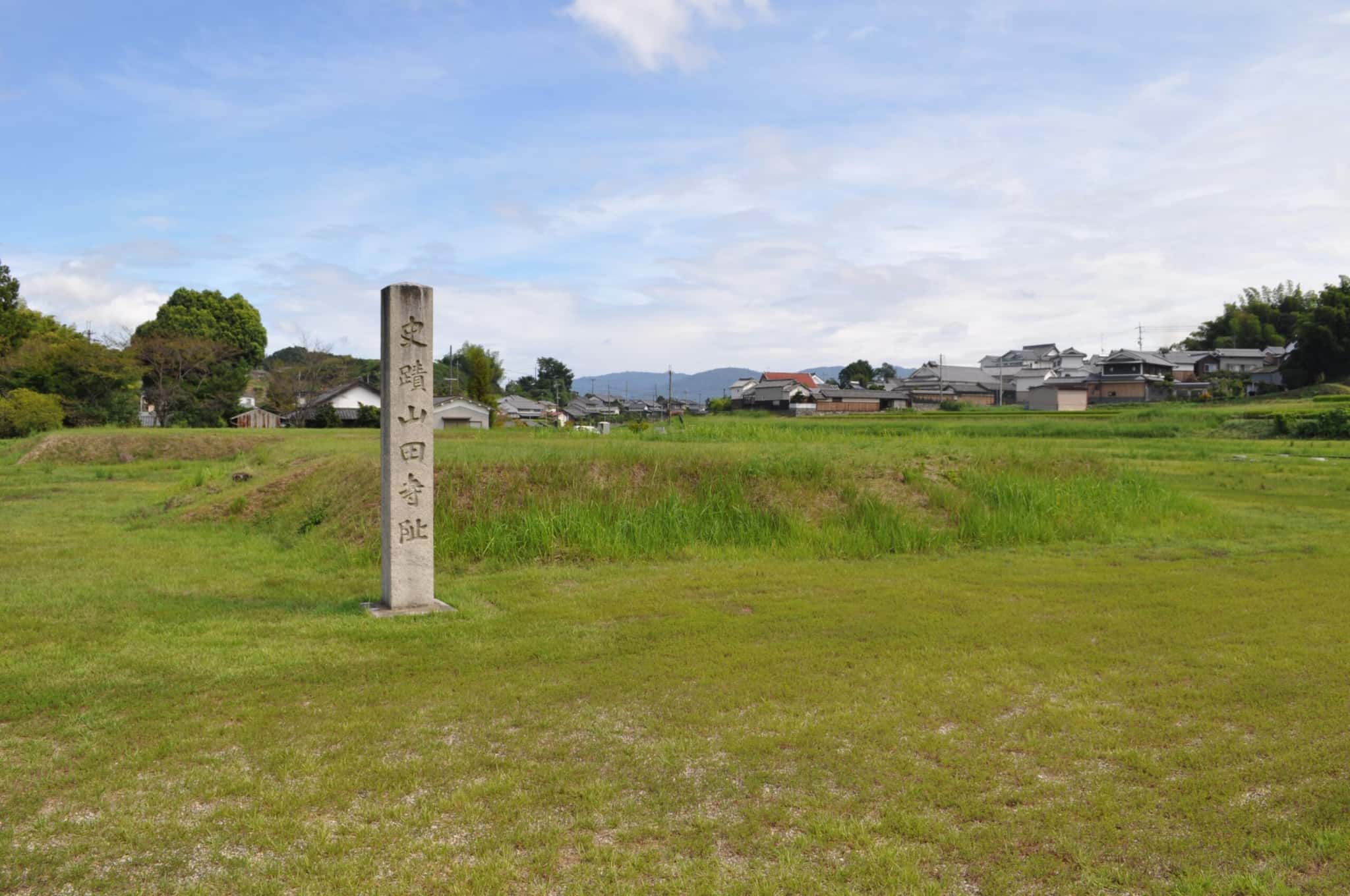
Yamada-dera Temple Site
The remains of a temple that reveal the architectural techniques of the 7th century.
Yamada-dera was a temple founded by Soga no Kurayamada Ishikawa Maro.
At the eastern cloister, one of the oldest known wooden structures was found, preserved in the state in which it had collapsed. It is exhibited at Asuka Historical Museum.
Kawara-dera Temple Site
The family temple of the imperial lineage, deeply influenced by Tang Chinese culture.
It was built by Emperor Tenji to honor his late mother, Empress Saimei, and features a distinctive temple layout unique to Japan.

Ishibutai Mounded Tomb
A massive square tomb influenced by Chinese funerary architecture, built for a powerful noble family.
Constructed in the early 7th century, the tumulus measures about 50 meters on each side and contains a stone-lined chamber made of huge boulders. It is widely believed to be the tomb of Soga no Umako, the head of the most powerful clan at the time.

Kengoshizuka Mounded Tomb
An octagonal tomb representing a uniquely Japanese form of burial mound.
Built in the late 7th century with a diameter of about 22 meters, it features a stone chamber divided into two rooms carved from a single massive rock.

Mounded Tomb of Emperor Temmu and Empress Jito
An octagonal tomb aligned precisely along the central axis of the Fujiwara Palace.
Constructed in the late 7th century with a diameter of about 42 meters, this is the joint imperial mausoleum of Emperor Tenmu and Empress Jito, located directly south of the palace complex.

Kitora Mounded Tomb
The world's oldest astronomical chart and the four deities preserved in perfect form.
A round tomb about 14 meters in diameter, built at the end of the 7th century. Wall paintings of the four deities, the Twelve Zodiac Animals, and the astronomical chart are depicted inside the stone chamber.

Takamatsuzuka Mounded Tomb
The vividly colored murals that represent international exchange in East Asia remain.
A round tomb about 23 meters in diameter, built in the early 8th century. Wall paintings of the four deities, the group of women, the group of men and the constellation chart are depicted inside the stone chamber.

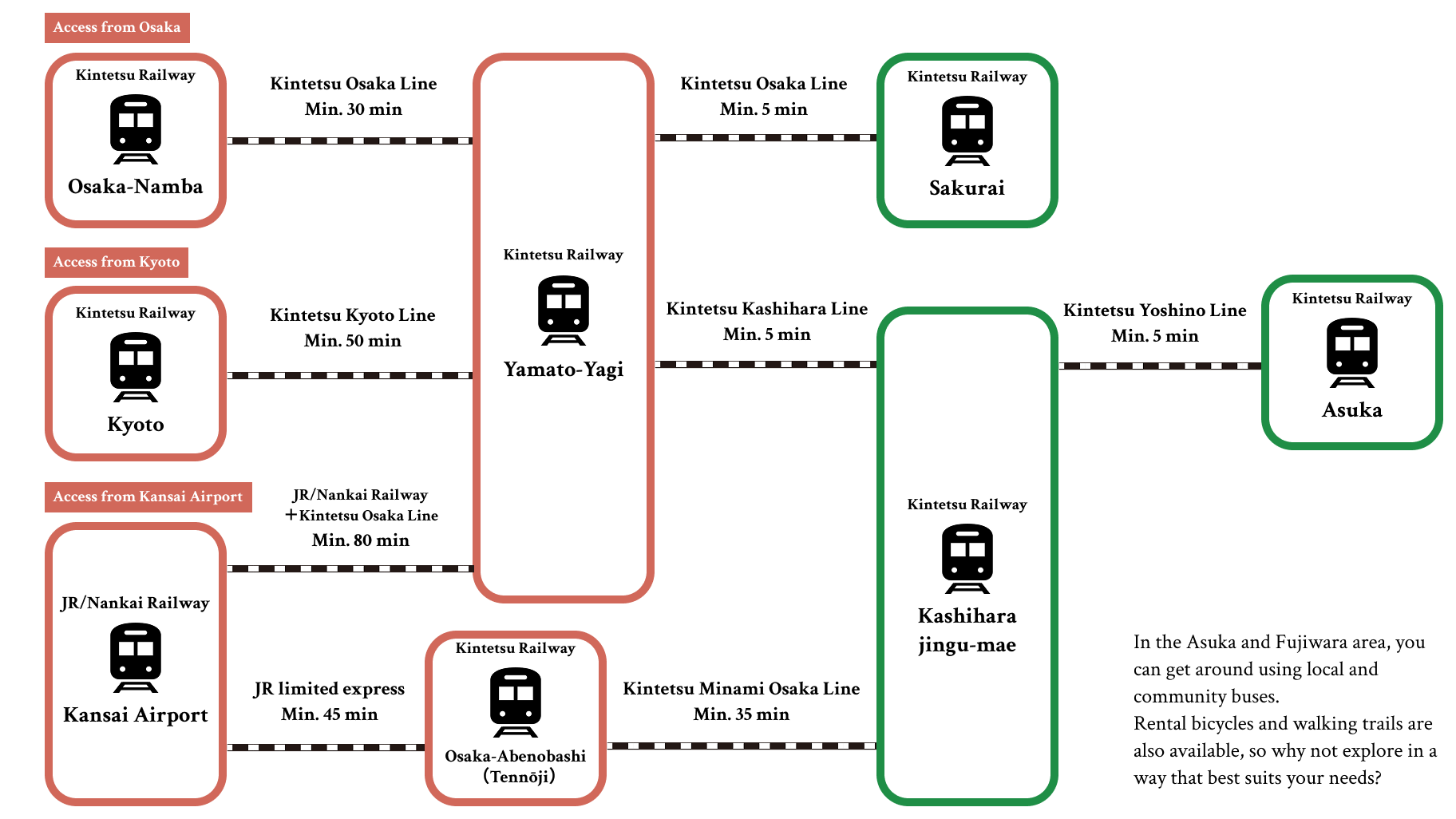
Access
Recommended Nearby Attractions
Nara Prefectural Manyo Culture Museum
A comprehensive cultural center focusing on ancient culture centered around the Manyoshu, befitting Nara, the hometown of the Manyo.
It combines functions for research and study of Japan’s ancient culture, exhibition activities that promote the culture related to the Manyo (Manyo Museum), and library and information services that collect and provide information on the Manyoshu (Manyo Library and Information Room).
- Nara Prefecture, Asuka Village, Asuka 10
-
10:00–17:30 (last admission 17:00)
Closed: Mondays (following weekday if Monday is a national holiday), year-end/New Year holidays, and during exhibit changes - https://www.manyo.jp/
- https://www.youtube.com/watch?v=lF4fn_9zE4k(English)
- https://www.youtube.com/watch?v=2uKirvYJUvQ(Japanese)
The Museum, Archaeological Institute of Kashihara, Nara Prefectural
At the Museum, Archaeological Institute of Kashihara, we have developed our permanent exhibit, Archaeology of Yamato, to help guests deepen their understanding of the history of Nara Prefecture, which occupies an important position in Japanese history, using artifacts excavated from archaeological sites in Nara Prefecture. In addition, special exhibitions are held twice a year in spring and autumn, and a preliminary exhibition of the latest excavation results, Excavating Yamato, is held in summer.
There is also a video library, archaeology library and information corner, rest area, and other facilities that you can use for free, as well as a museum shop, so please come and visit us.
- 50-2 Unebi-cho, Kashihara, Nara 634-0065 JAPAN
-
9 am - 5 pm(Admission until 4:30 pm)
Closed: Mondays
If Monday is a holiday, the museum will be open, and instead closed the following day.
The Museum also closes for the new year holidays (December 28–January 4).
In addition to the above, please note that there are several days when the museum is closed on an irregular basis each year. For details, please check the calendar on the home page.The Museum will be closed on days marked with X. - https://www.kashikoken.jp/museum/
Nara Prefecture Historical and Artistic Cultural Complex
Registered as a “Roadside Station,” the Nara Prefecture Historical and Artistic Cultural Complex is a multifunctional facility where visitors can experience the rich heritage of Nara through history, art, cuisine, and agriculture. It is Japan’s first center to publicly showcase restoration work in four fields of cultural properties—Buddhist sculptures, paintings and calligraphy, historic architecture, and archaeological artifacts. The complex also hosts creative workshops by artists, and art programs for young children. Beyond passive viewing, it encourages active dialogue and hands-on learning with experts, offering opportunities to explore Nara’s culture through all five senses.
- 437-3 Somanouchi-cho, Tenri City, Nara Prefecture
-
9:00–17:00 (Restaurants and rental halls open until 20:00; Market and Crafts Hall open until 18:00)
Information Center, restrooms and nursing room: open 24 hours
Closed: Mondays (open on holidays, closed the following weekday); year-end and New Year holidays (Dec. 28–Jan. 4) - https://www3.pref.nara.jp/bunkamura/
- https://www.youtube.com/watch?v=iBYq4_4Sv3A
Post
Post Insert
Photo:Asuka-Fujiwara World Heritage Inscription Promotion Council